Chekka reviews online listings, messages, URLs and requests for hidden scam risks — so you can make safer decisions before you pay, click, meet or share your details.
MVP in development. Controlled beta planned before public launch.
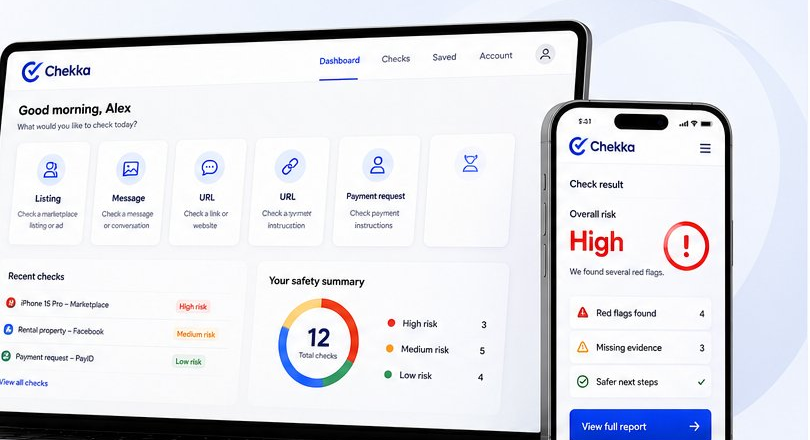
Illustrative product preview.
The cost of acting first, checking later
Sources: National Anti-Scam Centre · ACCC Targeting Scams (2024 and 2025) · ABS Personal Fraud 2024–25.
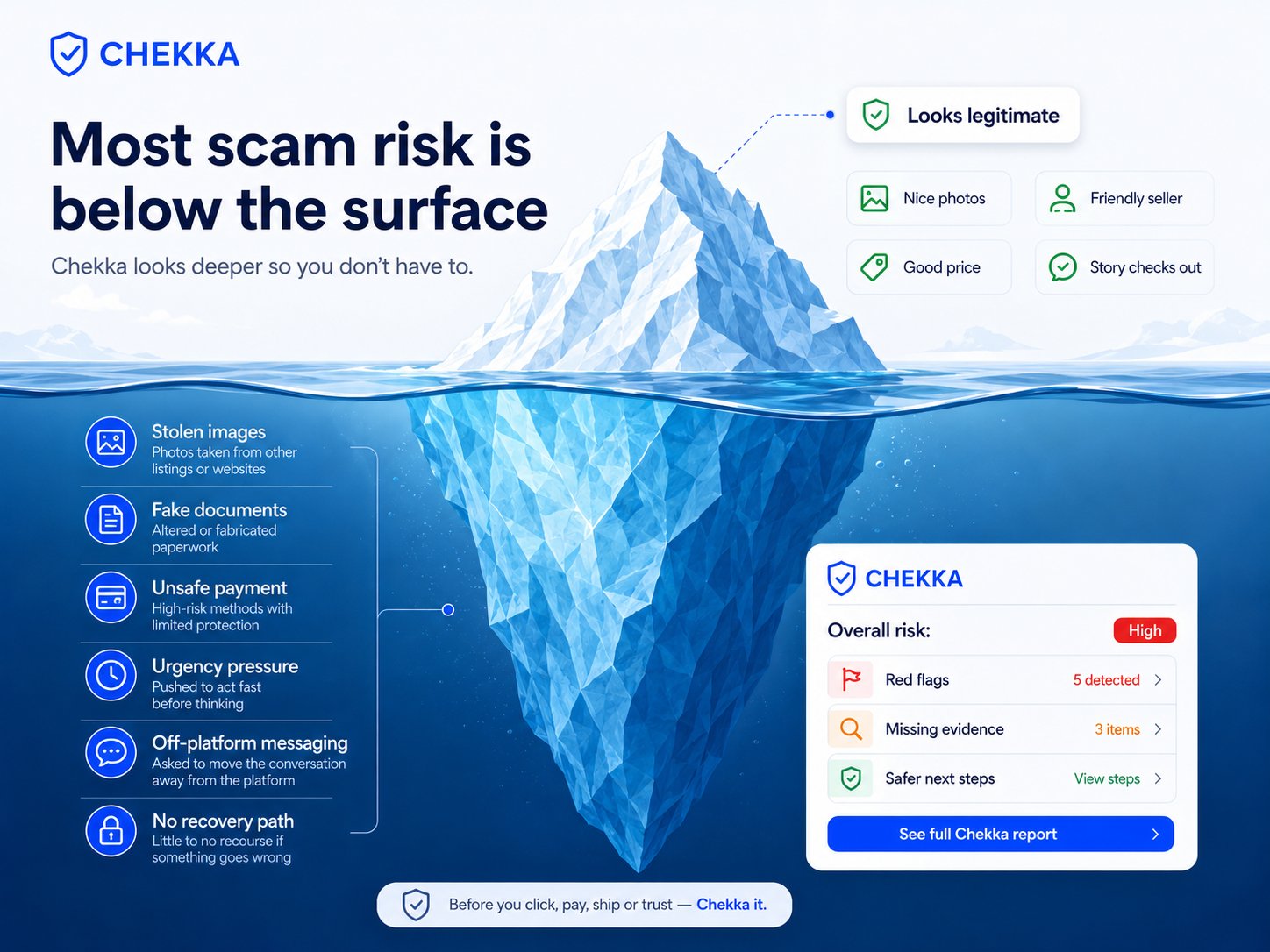
Chekka does not guarantee that a transaction is safe. It helps users make better decisions by identifying risk signals before they act.
Designed to be faster than the decision the user is about to make.
Paste a listing, URL, message, email or screenshot — whatever you've got.
Chekka reviews the signals, evidence and context across the whole interaction.
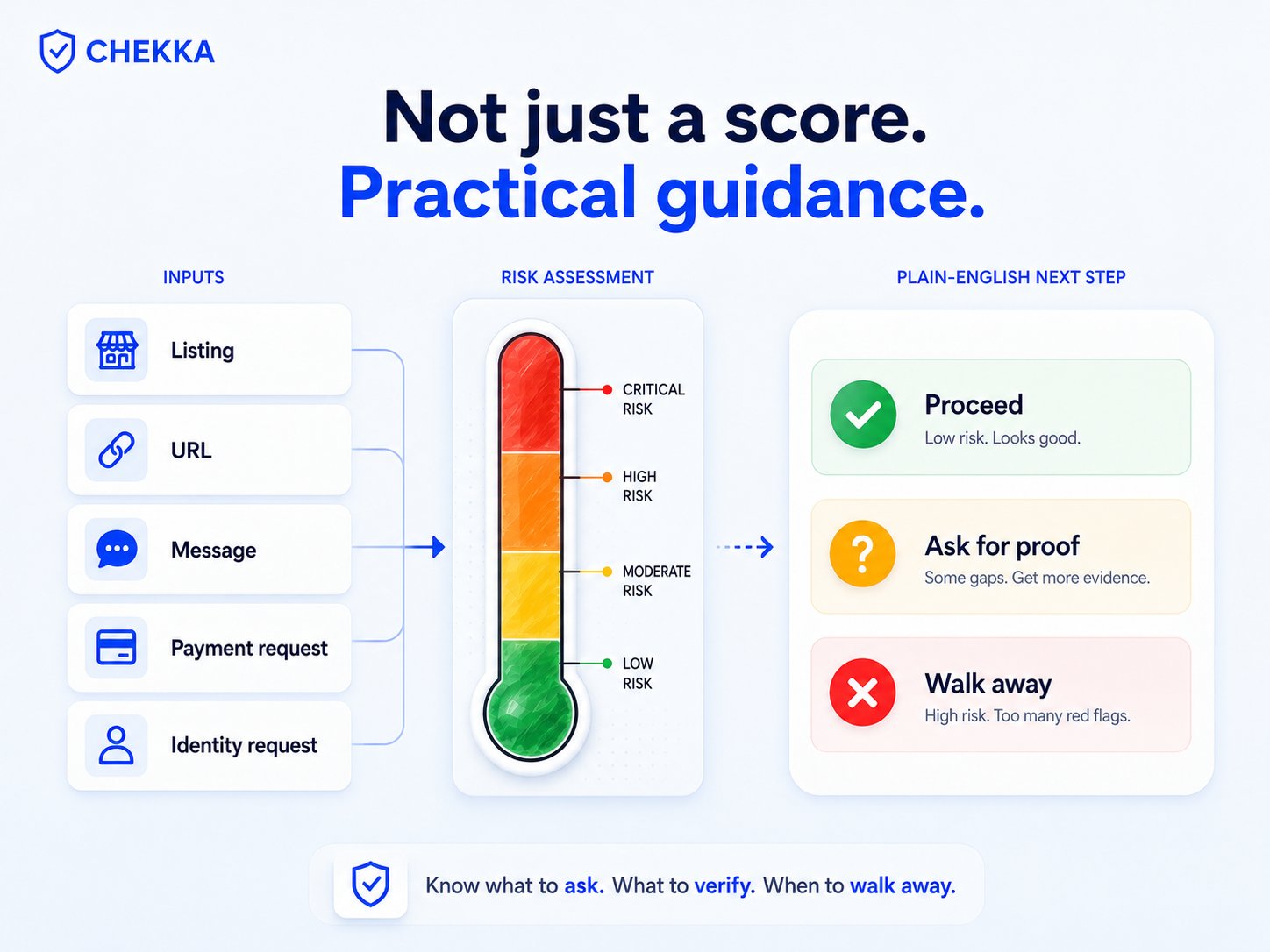
Get red flags, missing evidence and practical next steps before you act.
Chekka starts with the high-frequency consumer decisions and expands into higher-loss scam categories.
Marketplace, rentals, vehicles, electronics and more.
Suspicious chats, pressure tactics and payment requests.
Check links for fake sites, scam pages and phishing attempts.
PayID, bank details, crypto wallets and payment instructions.
Requests for ID, verification scams and impersonation.
Know what to ask, what to verify and when to walk away.
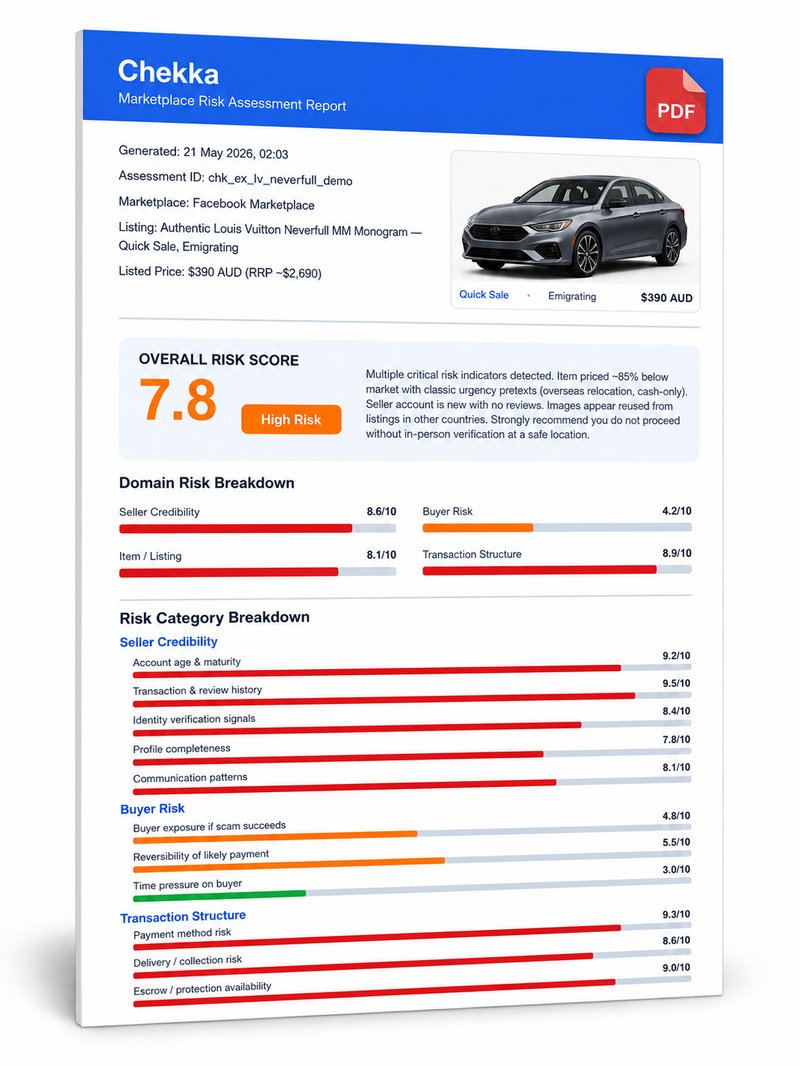
Here's a real 4-page sample showing how Chekka assesses a suspicious Facebook Marketplace listing.
Download sample report (PDF)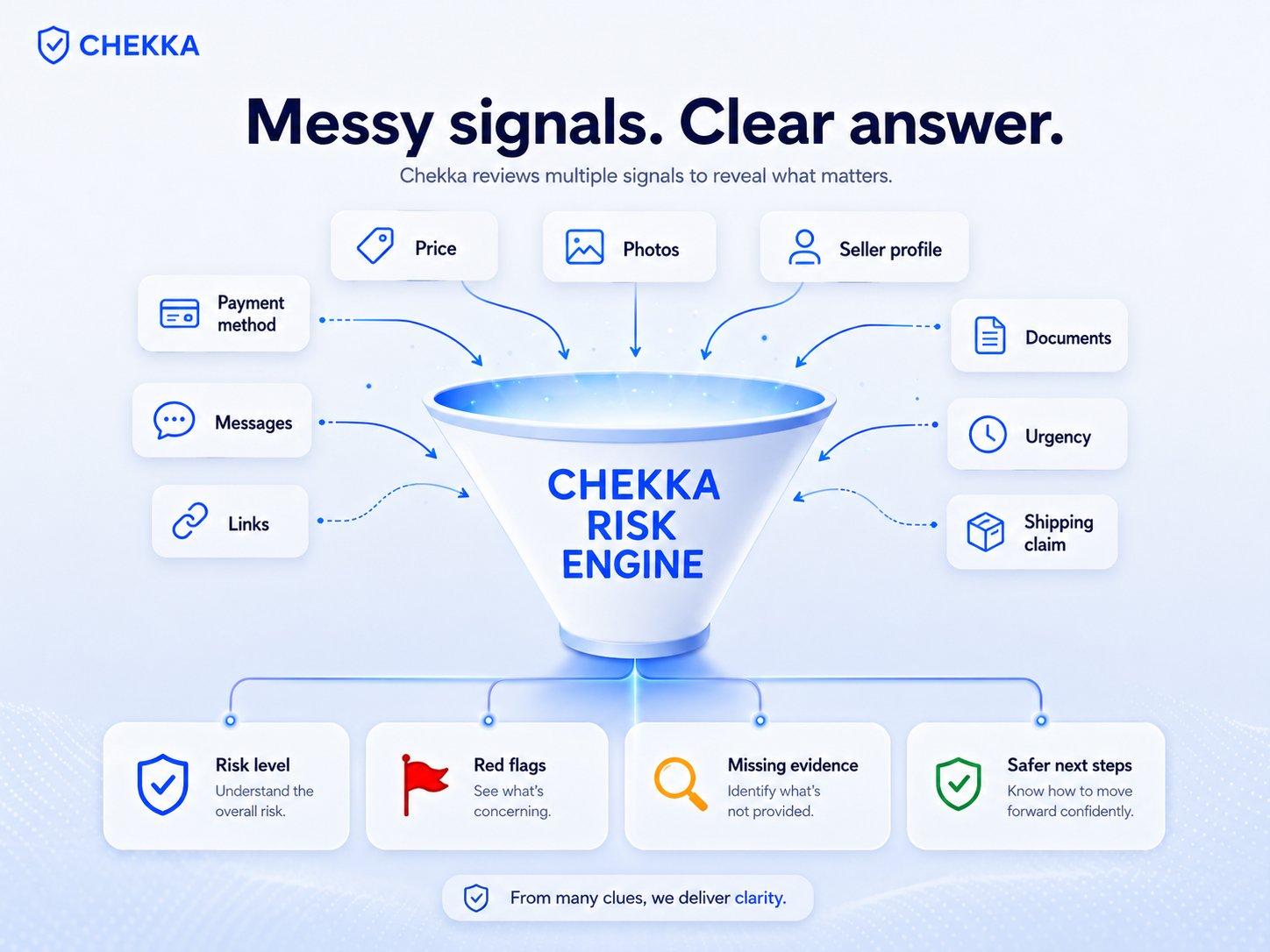

Illustrative example. Not a real listing.
Every story sharpens Chekka's risk detection — and helps the next person avoid the same trap. Share what happened to you, or what you nearly fell for. Anonymous, takes two minutes, no account required.
All submissions are anonymised and used only to improve scam detection.
Share your storyNo single marketplace, bank, browser, telco or regulator sees the whole scam journey. A consumer may see the listing in one place, continue the conversation elsewhere, receive a link through another channel and pay through a completely different method. That fragmentation is where scammers operate.
Chekka is positioned as a pre-transaction risk intelligence layer: the check a consumer reaches for before they act, regardless of where the interaction started. The initial wedge is marketplace listings, suspicious messages and URLs. The expansion path moves into higher-severity decisions including payment requests, investment offers, romance manipulation, rental deposits and job-offer fraud.
Commercially, Chekka begins direct-to-consumer and grows toward B2B2C partnerships with marketplaces, banks, insurers, telcos and consumer-facing services that benefit from reducing scam exposure for their own users. The same assessment engine can support multiple categories, channels and partner use cases.
In 2024, four of the five highest-loss Australian scam categories — investment, romance, payment redirection and phishing — were either directly within Chekka's MVP scope or on its near-term roadmap.
Chekka is not trying to be another generic scam awareness website. It is building a structured consumer risk-intelligence engine that can be reused across multiple scam types, transaction types and distribution channels.
The product creates value in three ways: helping consumers avoid preventable losses, generating structured risk data across scam categories, and giving future partners a consumer-facing prevention layer that sits before disputes, chargebacks, complaints and reputational damage.
Chekka uses a credit-based model. Consumers buy credit packs and spend credits on checks. Simple URL or message checks consume fewer credits. Deeper transaction, payment-request or investment-offer checks consume more. The model is designed for both everyday caution and occasional high-stakes decisions.
A handful of credits for one-off checks. For first-time users testing the waters before a single trust-based decision.
A practical credit balance for regular caution. For people who buy, sell or receive risky messages online often enough to keep Chekka on hand.
A larger credit balance with the best per-check value. For families, frequent users, or anyone weighing higher-value decisions.
No subscription required. Credits valid for 12 months.
Chekka is private by design. We only analyse what you submit to generate your report. Your data is never shared without your consent.
Chekka does not guarantee that any person, listing, message, link, payment request or transaction is safe. It helps users make better decisions by identifying risk signals before they act.
We started Chekka because the scam economy has moved faster than the tools meant to stop it. We have both been scammed personally, and we recently came close to losing thousands to a fake car listing complete with convincing photos, false documents and a story that held up under questioning. We were lucky. Most people are not. Chekka is what we wish we had before we trusted the wrong signals.
Drives Chekka's product, commercial strategy and go-to-market. Has spent a career turning complex technology into clear customer value, and is focused on making consumer scam-risk intelligence simple enough for everyday use and credible enough for serious commercial adoption.
Shapes Chekka's user experience, risk-assessment logic and consumer narrative. Brings the everyday consumer lens to each product decision, with a focus on helping people slow down, verify and avoid preventable losses before the damage is done.
Scope, pricing, and what to expect from a Chekka assessment.
More questions? Reach us at hello@chekka.ai.
Join early access and help shape the safer way to check online transactions.
Controlled beta planned ahead of public launch.
Join the early access list and we will let you know when beta checks become available for listings, messages, links and payment requests.
We will be in touch as beta access opens.
Chekka is currently in MVP build with a controlled beta planned before public launch. The public website is intentionally informative rather than fully transactional at this stage. The near-term goal is to validate demand, pricing, risk-assessment quality and willingness to pay across initial check types, then expand into higher-value scam categories where the pain and urgency are strongest.
Contact the founders