
Marketplace scams happen on every platform — Facebook Marketplace, Gumtree, eBay, Depop, OfferUp, OLX, Craigslist, Vinted — and on every type of product, from phones and cars to rentals, pets, tickets and designer goods. In Australia, buying-and-selling scams were the most reported scam type involving financial loss in 2025 (ACCC National Anti-Scam Centre). The numbers look similar in other markets.
The listings change. The language changes. The platforms change. But the underlying mechanics rarely do. Most marketplace scams reuse the same handful of patterns with different photos and different excuses.
Once you can name those patterns, you have a much better chance of slowing down before money changes hands.
Why patterns matter more than scam names
You do not need to know whether something is "authorised push payment fraud" or "advance-fee fraud" or any other piece of industry jargon.
What matters is simpler:
What is this person asking me to do? Does it make sense? Does it match how a normal, safe transaction would usually work?
Scammers constantly change the surface details, but they tend to reuse the same underlying moves. The item changes. The excuse changes. The pressure changes. The mechanics often do not.
Here are five patterns that sit behind a large share of marketplace fraud.
Pattern 1: Fake listing, no delivery
This is the classic one.
You find an item. The price looks good. The seller seems friendly enough. You pay. Then the item never arrives.
Sometimes the seller disappears straight away. Sometimes they keep you waiting with excuses. Sometimes they send a tracking number that does not work or belongs to something unrelated.
This pattern works because fake listings can look completely normal at first glance. The photos can be clean. The description can be believable. The price can be just low enough to feel like a good deal without looking obviously fake.
It is common with phones, gaming consoles, designer items, car parts, furniture, pets and anything else where photos are easy to copy or reuse.
What to watch for: Sellers who push for payment before inspection, give vague answers to specific questions, or say they are interstate, overseas, travelling or working away. Run a reverse image search on the photos — fake listings often reuse images that appear elsewhere on the web.
Pattern 2: Payment manipulation
This is where the scam moves from the listing to the money.
The seller or buyer tries to change the payment process in a way that removes your protection and benefits them. It might be a fake payment confirmation, an "accidental" overpayment with a request to refund the difference, a fake escrow page, a QR code, a courier fee, a verification payment, or a link that looks like a legitimate payment page but is not.
This pattern is dangerous because it happens right at the point where people feel the deal is almost done. You have already decided you want the item or want to sell it. Your guard is lower. And once money has been sent through a fast bank transfer, peer-to-peer payment app, crypto wallet or gift card, recovery is often very difficult.
What to watch for: Any story that involves sending money to a third party, paying a courier upfront, using an unfamiliar escrow link, buying gift cards, scanning a QR code, or refunding money that has not actually cleared in your account. A screenshot of a payment is not the same as money arriving.
Pattern 3: Moving you off the platform
This one is slightly different — it is a behavioural signal rather than a single move, and it often appears alongside the others.
"Can we move to WhatsApp?" "Message me on this number." "I'm not getting notifications here."
There are legitimate reasons someone might want to move a conversation. Apps glitch. Notifications fail. Some people prefer texting. But in marketplace scams, moving you off-platform is often an early warning sign — especially when it happens quickly and is followed by talk of payment, delivery or verification.
Once the conversation leaves the marketplace, the platform has less visibility. Any built-in buyer or seller protection becomes harder to rely on. The scammer also has more freedom to send links, fake payment pages or pressure messages that the platform might otherwise block.
What to watch for: An early push to move to WhatsApp, SMS, email or Telegram — especially if the other person quickly starts talking about payment, delivery, deposits or third-party services.
Pattern 4: Counterfeit, faulty or misrepresented items
This one is different because something may actually arrive. The problem is that it is not what you thought you were buying.
It might be a fake handbag, a locked or stolen phone, a car with a tampered VIN, a damaged appliance, a cloned ticket, or an item described as "barely used" that clearly has a problem.
This pattern is hard to spot from the listing alone because the listing can look legitimate. The real issue only appears when you inspect the item, check serial numbers, test the product, verify ownership, or compare it to what was advertised. That means your best protection is the work you do before committing.
What to watch for: Sellers who will not provide serial numbers, IMEI numbers, VINs, live video, extra photos or a chance to inspect the item. Be especially careful with "posted only" listings, screenshots of receipts, and prices well below the normal market range.
Pattern 5: Pressure and emotional manipulation
This is the layer that often sits on top of the other four.
The scammer gives you a reason to hurry. "Three people are interested." "I need it gone today." "I'm moving overseas." "My partner is handling delivery." "My parent just passed away."
Some of these stories might be true — that is what makes the pattern effective. The goal is not always to tell a ridiculous story. The goal is to make you feel rushed, guilty, flattered or afraid of missing out. Once that happens, you are more likely to skip the checks you would normally do.
What to watch for: Any reason you are being given for not taking your time. A genuine seller may be busy, but they should not have a problem with reasonable questions or basic proof.
The real danger is when patterns stack
Most scams do not rely on just one red flag. They stack several together.
A cheap phone listed by a new profile. The seller wants to move to WhatsApp. They say they are travelling. They want payment now because someone else is interested. They send a courier story.
That is not one concern. That is several patterns working together.
Before acting on a marketplace deal, ask yourself:
- Am I being asked to pay before I inspect the item?
- Is the payment method hard to reverse?
- Has the conversation moved away from the platform?
- Are there details I have not been able to verify?
- Is the other person trying to rush me?
- Do I feel awkward asking for proof?
If two or more of those answers are yes, slow down.
Ask for more evidence. Check the photos. Verify the seller. Compare the price. Talk to someone else before sending money.
A genuine deal will usually survive a few extra checks. A scam often will not.
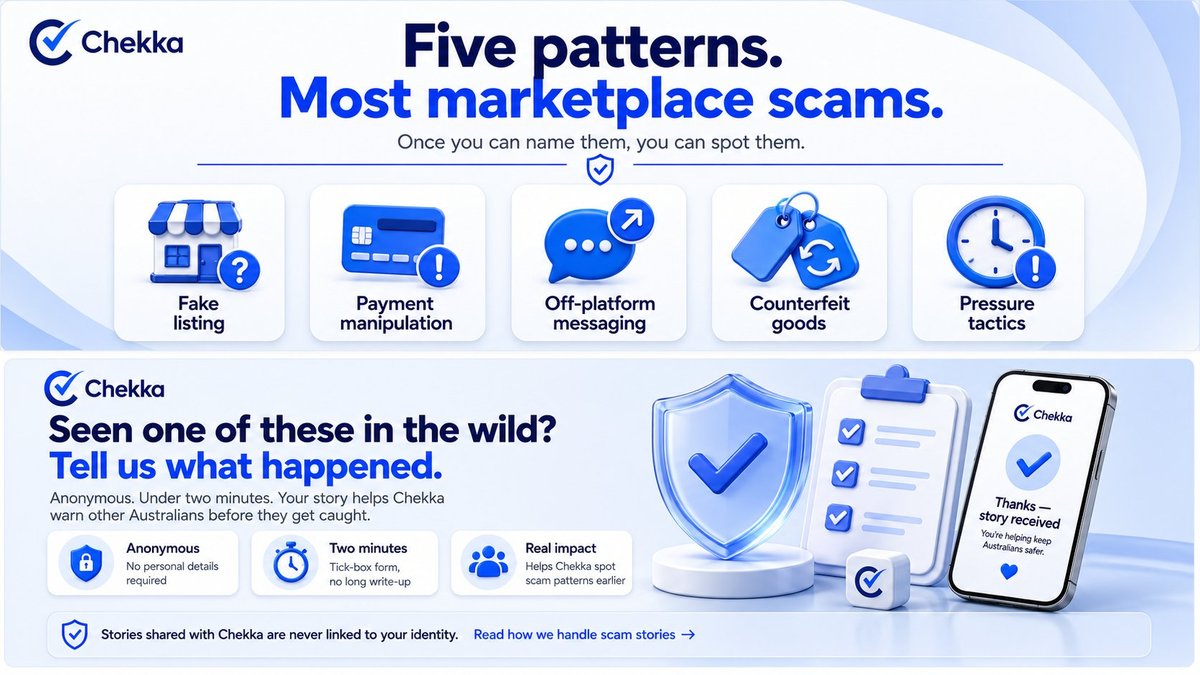
Seen one of these in the wild? Chekka is collecting anonymous scam stories so we can identify patterns earlier and warn people before they get caught. It takes under two minutes and your details are never linked to your story.